
KZ Mast Bearing for Forklifts
What is a Mast Bearing?
The KZ Mast Bearing is a precision-engineered component designed to ensure smooth mast rotation and enhanced durability for demanding marine applications.
A mast bearing is a heavy-duty specialized roller designed to handle the intense vertical and lateral loads of a forklift's lifting mechanism. They serve as the critical interface between the moving sections of the mast and the fork carriage, ensuring smooth, telescopic movement under extreme pressure.
________________________________________
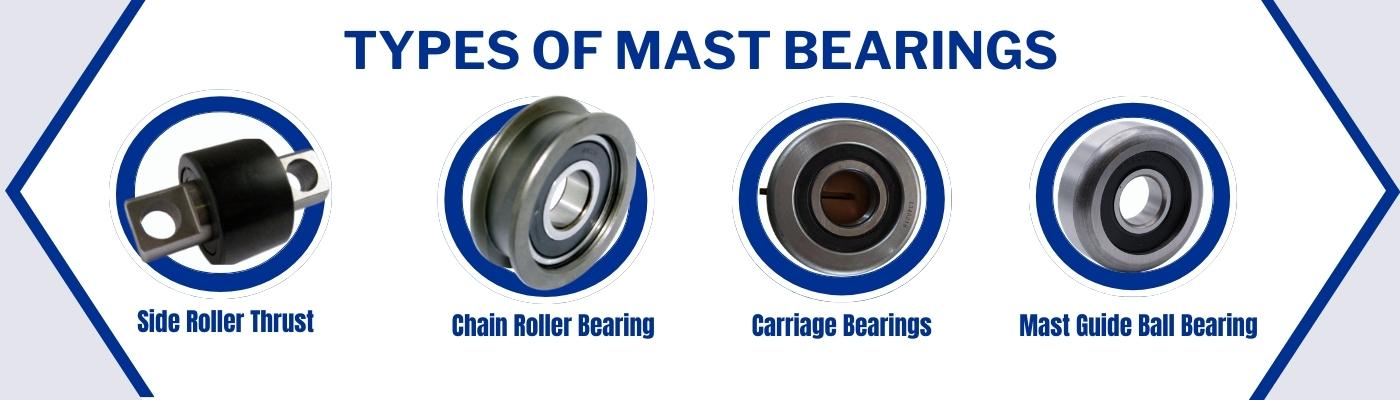
The Four Primary Types
Mast guide bearings – these bearings guide the mast stages up as the forks are raised beyond the first stage. They also attach the fork carriage to the mast rails.
Carriage bearings – these provide lateral guidance to the fork carriage as it travels up the mast. They are typically smaller than the mast guide bearings.
Side thrust rollers – these bearings transfer the lateral (sideways) loads to the mast and help to prevent twist. Typically they are mounted on a shaft (pin).
Chain roller bearings – these guide the leaf chain that raises & lowers the mast. The bearings are usually flanged like a pulley to ensure the chain is captive.
________________________________________
Application Across Equipment
A mast bearing in a forklift is a critical load-bearing component that supports the mast assembly, allowing it to move smoothly during lifting, lowering, and tilting operations.
These bearings reduce friction between the mast rails and rollers, ensuring:
Smooth vertical travel of the carriage, Stable load handling, Reduced wear on mast channels, Improved operator control and safety
In demanding warehouse and industrial environments, high-quality mast bearings enhance durability, minimize maintenance, and maintain consistent lifting performance under heavy loads.
Counterbalance Forklifts
In a standard forklift, the mast bearings are the primary point of contact between the inner and outer mast rails.
The Job: They must handle extreme leverage. Because the load is sitting out on forks in front of the wheels, the bearings are constantly being "squeezed" between the rails.
Bearing Role: They allow the telescopic sections to extend smoothly under massive pressure. Without high-quality mast rollers, the friction would be so high the hydraulics might stall or the mast would "jump" dangerously.
Reach Trucks
Reach trucks are designed for narrow aisles and very high shelving.
The Job: These machines have a "reach mechanism" that moves the entire mast assembly forward and backward on a set of tracks.
Bearing Role: You’ll find mast bearings not just in the vertical lift, but also in the pantograph (the scissor-like reach mechanism). These bearings ensure that when the operator "reaches" into a rack, the movement is pinpoint accurate and doesn't sway side-to-side, which could knock over a pallet.
Pallet Stackers
Stackers are essentially "walkie" forklifts. They are smaller and often used for lighter loads, but they are more "top-heavy" relative to their size.
The Job: Because stackers are often used in tight retail spaces or small backrooms, the mast needs to be compact.
Bearing Role: Stackers often use combined bearings (a radial bearing with a small side-roller inside). This allows the mast to be narrower while still providing enough stability to keep the load from tipping when the operator is turning a tight corner.
Warehouse Lifts (VNA & ASRS)
In Very Narrow Aisle (VNA) trucks or Automated Storage and Retrieval Systems (ASRS), the "warehouse lift" is often moving at high speeds and reaching heights of 40+ feet.
The Job: Speed and height. At 40 feet up, a millimeter of "play" or wobble in a bearing translates to several inches of swaying at the forks.
Bearing Role: These use high-precision side-thrust rollers. These bearings act as "guides" that hug the mast rails tightly to eliminate any lateral (side-to-side) movement. They ensure that even at maximum extension, the lift remains rigid and safe.
Pallet Stackers
Stackers are essentially "walkie" forklifts. They are smaller and often used for lighter loads, but they are more "top-heavy" relative to their size.
The Job: Because stackers are often used in tight retail spaces or small backrooms, the mast needs to be compact.
Bearing Role: Stackers often use combined bearings (a radial bearing with a small side-roller inside). This allows the mast to be narrower while still providing enough stability to keep the load from tipping when the operator is turning a tight corner.
Warehouse Lifts (VNA & ASRS)
In Very Narrow Aisle (VNA) trucks or Automated Storage and Retrieval Systems (ASRS), the "warehouse lift" is often moving at high speeds and reaching heights of 40+ feet.
The Job: Speed and height. At 40 feet up, a millimeter of "play" or wobble in a bearing translates to several inches of swaying at the forks.
Bearing Role: These use high-precision side-thrust rollers. These bearings act as "guides" that hug the mast rails tightly to eliminate any lateral (side-to-side) movement. They ensure that even at maximum extension, the lift remains rigid and safe.
the KZ Mast Bearing delivers reliable performance, reduced friction, and long-lasting durability, making it an essential upgrade for smoother mast operation and improved overall sailing efficiency.